





Universal Commerce Protocol (UCP) explained: what it is, who backs it, what's confirmed so far, and what a Shopify merchant should do about it this quarter.
Shopify says AI searches powered by Shopify Catalog convert at 2x the rate of those using scraped data (Shopify Newsroom, 17 June 2026). Same products, same prices — the difference is whether the machine reading your store got clean structured data or had to guess from your HTML.
That gap is what the Universal Commerce Protocol exists to close. And here is the uncomfortable part for anyone who has spent five years optimizing a theme: when an agent buys on your behalf, your product data is the storefront. Nobody sees your hero section. The agent reads your fields, negotiates your checkout, and moves on.
Key takeaways
- UCP is an open standard for AI agents to transact with businesses, co-developed by Google and Shopify and announced 11 January 2026. The spec is public under Apache 2.0, and it covers the whole lifecycle — catalog search, cart, identity linking, checkout, payment and post-purchase orders — not just the payment step.
- You stay the merchant of record. Your pricing, discount rules, checkout logic and customer relationship do not move to the agent.
- Shopify merchants are UCP-enabled by default (Shopify, 17 June 2026). There is no integration to build — the work is in your product data and your settings.
- UCP is not OpenAI's ACP. They are two different standards from two different groups. Shopify manages both kinds of channel from one place in the admin.
- What's still unannounced matters — coverage outside the US, which agents get direct checkout, and how attribution settles. Plan for the parts that are confirmed.
On this page:
- What is the Universal Commerce Protocol?
- Who is behind UCP, and what is actually confirmed
- How an agent purchase differs from a normal session
- UCP, ACP and Agentic Storefronts are three different things
- What your store needs to already have in place
- In your control today vs waiting on the platform
- What to do this quarter
- Universal Commerce Protocol FAQ
What is the Universal Commerce Protocol?
The Universal Commerce Protocol (UCP) is an open standard that gives AI agents and businesses one shared language for the full commerce lifecycle — product discovery, cart building, identity linking, checkout, payment and post-purchase order management. It was co-developed by Google and Shopify, announced on 11 January 2026, and published as a public specification at ucp.dev under the Apache 2.0 licence.
In plain terms: instead of every AI assistant building a custom integration with every store, a business publishes one machine-readable profile describing what its checkout can do, and any compliant agent can read it and transact. PageFly, a Shopify page builder, has been tracking this shift through our agentic commerce coverage — UCP is the plumbing underneath it.
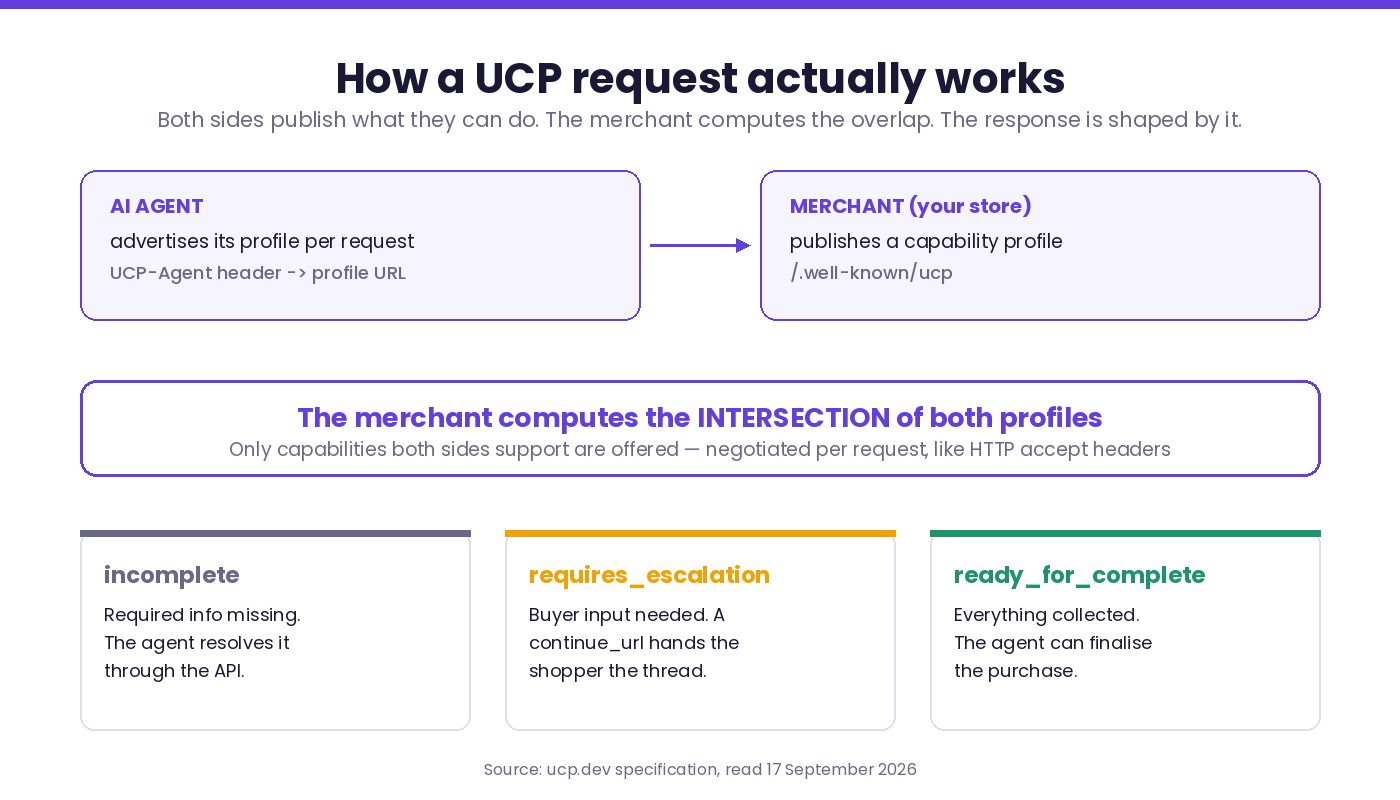
Mechanically, a UCP business publishes a capability profile at /.well-known/ucp on its domain. Platforms advertise their own profile URL on each request through a UCP-Agent header. The business then computes the intersection of what both sides declare, and the response carries the active capability set. Shopify's own framing compares this to the way HTTP already negotiates content on every request.
Two design choices are worth understanding because they decide how fast this ecosystem moves:
- Layered, not monolithic. Services group the operations for a vertical (
dev.ucp.shopping,dev.ucp.common). Capabilities — checkout, cart, catalog search, orders, identity linking — are the verbs, each versioned by date. Extensions such as discounts, fulfillment and loyalty compose onto a base capability and are pruned automatically if their parent is not in the negotiated set. - No approval committee. UCP uses reverse-domain naming:
dev.ucp.shopping.*is governed by ucp.dev,dev.shopify.catalogby Shopify,com.yourvendor.*by yourvendor.com. Own the domain, own the namespace. A loyalty vendor can ship an extension without asking anyone's permission, and because negotiation is opt-in on both sides, it only activates where both parties declare it.
It is built on ordinary web plumbing — REST and JSON-RPC transports, with support for the Agent Payments Protocol (AP2), Agent2Agent (A2A) and Model Context Protocol built in.
The problem UCP is trying to solve
Commerce is messy in ways that break naive integrations. Payment options differ by cart, buyer and market. Discount stacking rules get genuinely intricate. Fulfillment explodes into shipping, pickup, local delivery, split shipments, pre-orders, delivery windows and subscription schedules.
Any agent that wants to complete a real purchase has to survive all of that. Before UCP the options were both bad: scrape the storefront and hope, or build a bespoke integration per platform. Scraping is why the 2x conversion gap above exists — an agent guessing at your variants from rendered HTML gets it wrong often enough to matter.
This matters because the failure mode is not "ranked lower." AI shopping assistants decompose a request into hard filters — ships to Canada, under $200, in stock, machine washable — and a product missing one of those attributes drops out of the answer set entirely. That is the same discipline behind good product page SEO, applied to structured commerce data instead of page copy.
Who is behind UCP, and what is actually confirmed
UCP is co-developed by Google and Shopify. The shopping vertical's co-development group listed on ucp.dev as of 17 September 2026 also includes Etsy, Wayfair, Target, Walmart, Amazon, Microsoft, Meta, Salesforce and Stripe. The public endorsement list has grown to include Visa, Mastercard, PayPal, Klarna, Adyen, Worldpay, Checkout.com, The Home Depot, Best Buy, Sephora, Zalando, SAP and VTEX, among others. Separate co-development groups now exist for Lodging and Food.
That is a genuinely broad coalition. It is also young, and a lot of it is still roadmap. Here is the honest split.
| Claim | Status | Source |
|---|---|---|
| UCP spec is public, open source, Apache 2.0 | Confirmed | ucp.dev / GitHub |
| Co-developed by Google + Shopify | Confirmed | Shopify Newsroom, 17 Jun 2026 (linked above) |
| Business stays the merchant of record | Confirmed | ucp.dev |
| Shopify merchants are UCP-enabled by default | Confirmed | Shopify Newsroom, 17 Jun 2026 |
| Direct checkout live in Google AI Mode, Gemini, Copilot, Meta | Confirmed, per channel and eligibility | Shopify Help Center |
| Lodging and Food verticals | Announced, spec "coming soon" | ucp.dev |
| Which agents outside the named channels support UCP | Not announced | — |
| Country and currency coverage for direct checkout | Not published as a list | — |
| How UCP orders are attributed in third-party analytics | Not standardised | — |
| Whether UCP or OpenAI's ACP becomes the default | Genuinely unresolved | — |
If you read a confident answer to any of the bottom four rows, check the source. As of September 2026 nobody has published one, and a standard eight months old does not have a settled winner.
How an agent purchase differs from a normal session
A normal session is a human reading pages. An agent purchase is a negotiation between two programs, with the human pulled in only when required. The UCP checkout spec models this with a three-state lifecycle:
incomplete— required information is missing; the agent should try to resolve it through the API.requires_escalation— buyer input is needed. The response carries structured context plus acontinue_url, and the buyer picks up exactly where the agent left off.ready_for_complete— everything is collected and the agent can finalise the purchase programmatically.
That middle state is the interesting one. UCP's embedded checkout option lets the business's checkout render inside the agent's surface, with bidirectional communication and payment and shipping-address delegation, rather than forcing the shopper out to a browser tab.
Payments are negotiated the same way. The business advertises the payment handlers available for this cart in its profile and checkout response; the agent acquires a token from the credential provider and submits it back. Change the cart or the buyer's region and the handler list can change with it. Credentials only ever flow from agent to business — the spec forbids echoing them back.
Three practical consequences for a merchant:
- There is no landing page in the loop. No hero, no conversion rate work on that particular path, no cart drawer. The agent reads fields.
- Your theme is not in the loop either. Whatever you did in Horizon or a custom build is invisible on this path. It still matters for every human session, which is most of them.
- Identity is OAuth, not a login form. UCP uses OAuth 2.0 for account linking so agents hold authorised relationships without ever handling the customer's credentials.
- Post-purchase is in scope. Order status, tracking and returns flow back through the protocol via webhooks, which is why your policy pages suddenly count as product data.
UCP, ACP and Agentic Storefronts are three different things
These get used interchangeably and they are not synonyms. Getting the distinction right saves you from planning work that does not exist.
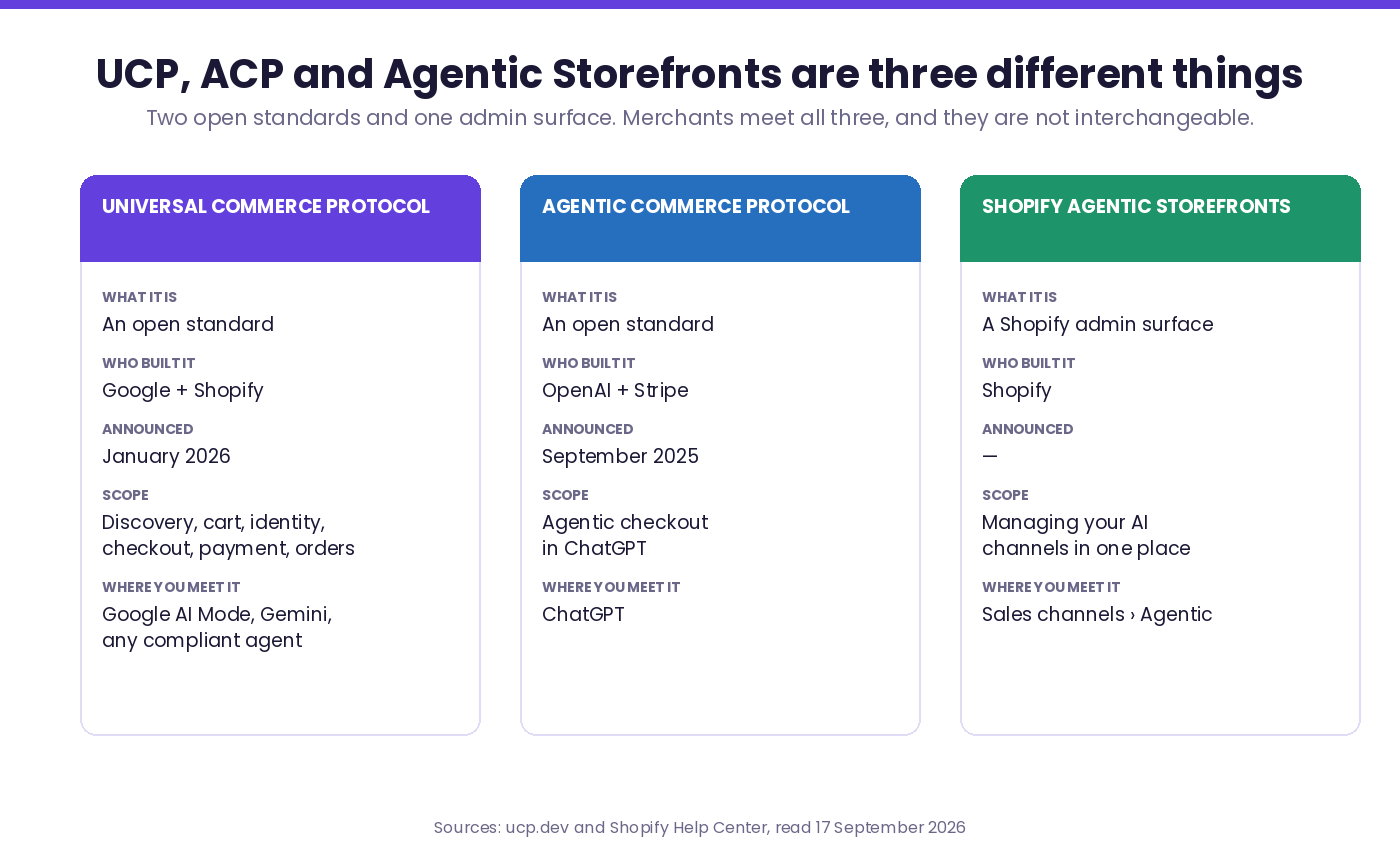
ACP is OpenAI's standard, co-developed with Stripe and published at developers.openai.com/commerce. UCP is the Google-and-Shopify standard. They are separate specifications with separate governance, and no public source says one has absorbed the other.
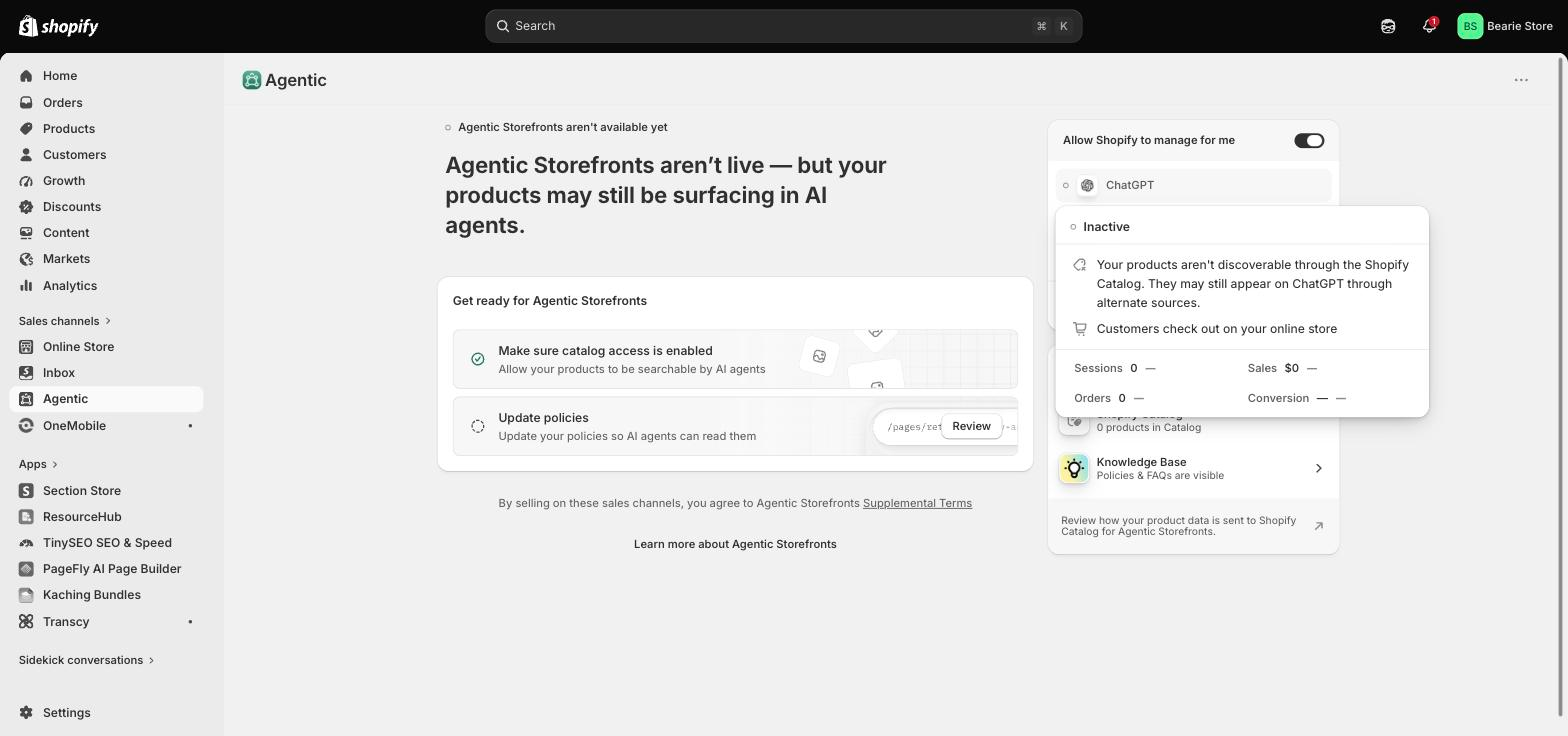
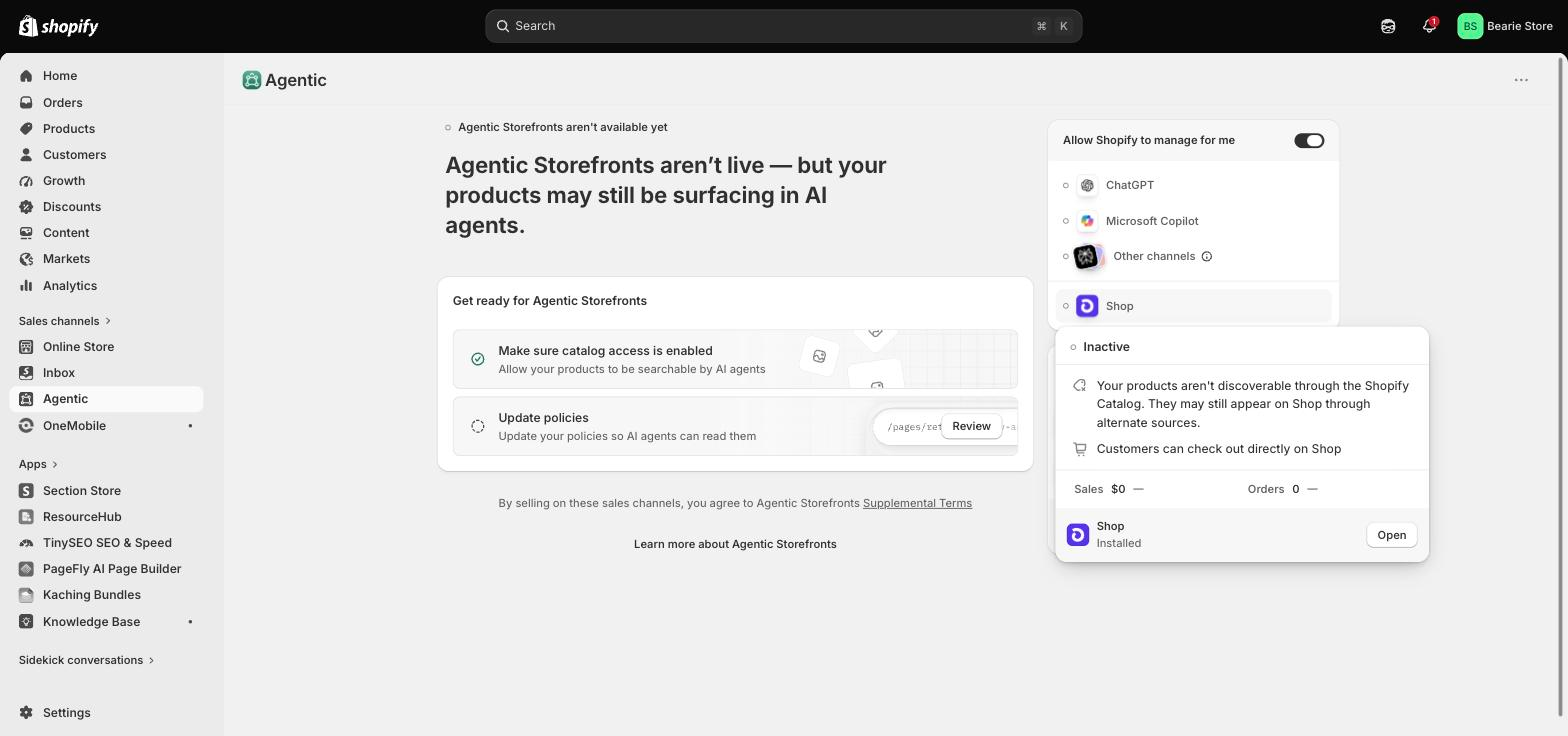
What Shopify has done is put both kinds of channel behind one control panel. Its Spring '26 announcement describes centrally managing AI channels — ChatGPT, Microsoft Copilot, AI Mode in Google Search, the Gemini app and Shop — from a single place in the admin. So as a merchant you are not choosing a protocol. You are choosing which channels can see your products. If you want the full picture of that admin surface, our guide to what replaced Shopify Instant Checkout covers the ChatGPT side specifically.
What your store needs to already have in place
Shopify merchants with eligible products are in Shopify Catalog by default, and Catalog is what feeds the agents. So the prerequisite is not code. It is completeness.
The admin's search preview tool scores each product on five listing-quality signals, and they read like a specification for what to fix:
- Description completeness. Measured on word count, because descriptions are what match a natural-language query. Thin descriptions are the most common gap, and they are the cheapest to fix.
- Image coverage. Number of product images, so the agent can represent the item in different contexts.
- Product reviews. Average rating and review count, counted only from sources Shopify verifies.
- Variant and option completeness. Number of variants and options, their stock status, and whether your option names contain acronyms or numbers an agent cannot interpret. "Colour: BLK-02" is a real ranking problem.
- Shop policy completeness. Shipping, returns and refund policies present. Policies signal legitimacy.
Two more things worth checking before you call this done. Agentic storefronts performance analytics are not yet available for headless stores, so if you run a custom storefront your reporting has a hole in it. And if you want a product hidden from every agent including Shop, the mechanism is Unlisted product status or the seo.hidden metafield — which also hides it from search engines.
If your catalog is large and messy, this is a data-hygiene project before it is a merchandising one. Shopify Search & Discovery settings and a tidy catalog structure do double duty here.
In your control today vs waiting on the platform
| In your control now | Waiting on the platform |
|---|---|
| Product descriptions, images, variants, policies | Which new agents get direct checkout |
| Channel and direct-checkout settings in the admin | Country and currency rollout for each channel |
| Whether Shopify auto-enrols you in new channels | Attribution standards across AI surfaces |
| Reviews and structured trust signals | Lodging and Food specs (announced, not published) |
| Your own site's answer-engine readiness | Whether ACP and UCP converge |
The left column is a week of work. The right column is not yours to schedule. Spend accordingly.
One thing that does sit in the left column and gets forgotten: your own site still has to be legible to assistants that read pages rather than transact. That is a different job from Catalog, and it is where generative engine optimization still pays.
What to do this quarter
Five steps, in the order that avoids rework.
Source: "Shopify's NEW Agentic Storefronts *Explained* (Shopify Editions Spring 2026)" — Ethercycle, YouTube, 14 July 2026. Third-party channel, not produced by PageFly or Shopify; it walks the Agentic section of the Shopify admin and the auto-enrolment behaviour described in step 1 below.
- Open Sales channels › Agentic in your admin and look at your actual settings. The default is Allow Shopify to manage for me, which activates every channel, turns on direct checkout where supported, and auto-enrols you in future channels. Decide deliberately whether that is what you want.
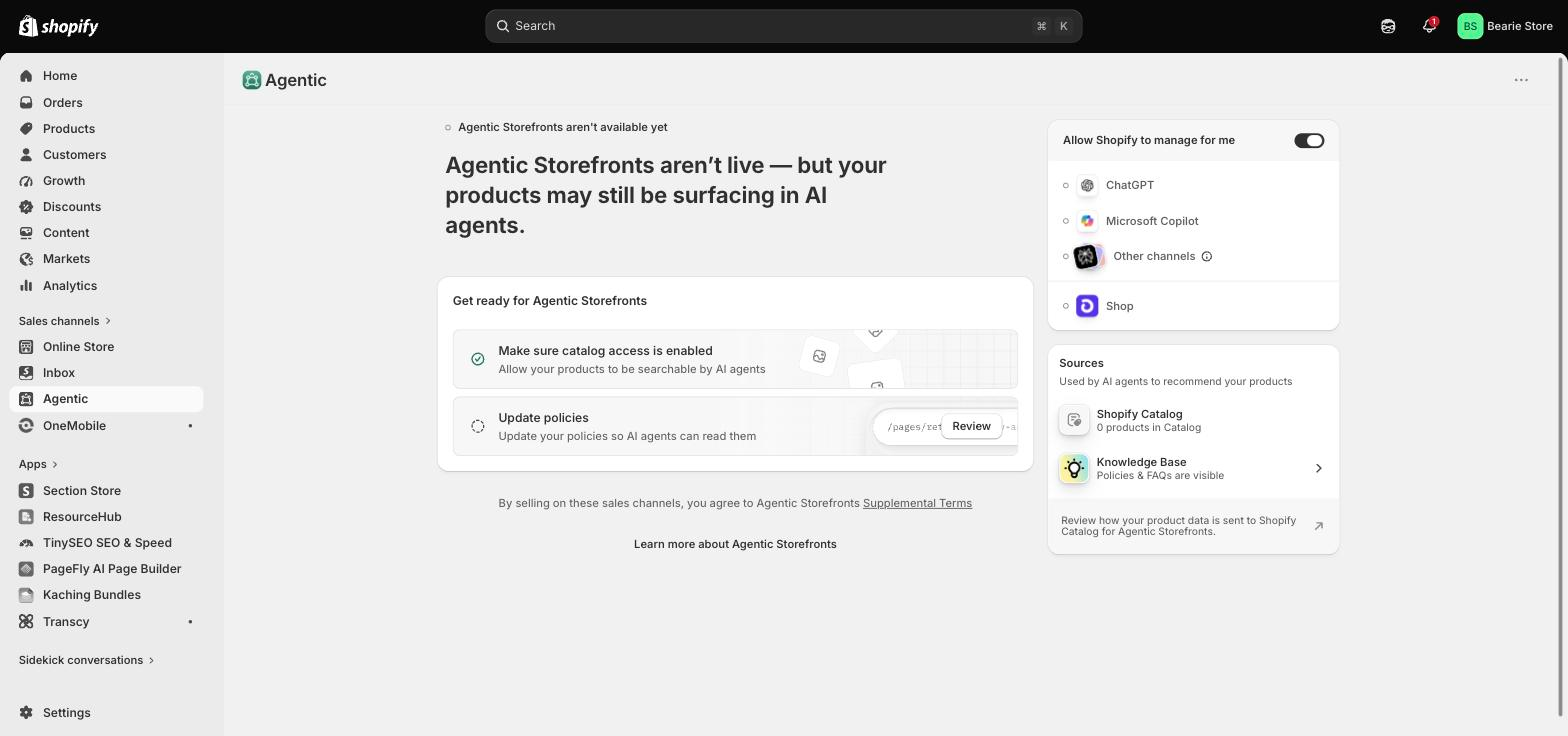
- Run the search preview on your five best-selling products. Type the query a customer would actually say, not your product title. The tool shows whether you rank in Shopify Catalog's results and breaks the listing-quality score into the five signals above. Shopify is explicit that channels often re-rank on their own logic, so treat it as a directional signal.
- Fix the cheapest signal first. In most stores that is description length and variant naming. Rewrite option names into words an agent can read, then extend thin descriptions with the attributes buyers filter on — material, fit, dimensions, compatibility, care. Reusable sections make it far quicker to apply the same spec block across a whole collection, and the PageFly template library covers the common product-page shapes if you would rather not start from a blank canvas.
- Check your policy pages exist and say something. Shipping, returns and refunds. This is a 20-minute job that moves a scored signal.
- Set a baseline before the numbers move. The Agentic section reports sales, orders, online store sessions and conversion per AI channel, with no historical backfill — so the screenshot you take today is the only "before" that will ever exist. If you also run A/B tests on your own site, keep the two measurement systems separate; agent traffic does not behave like a session.
What this does not require: a replatform, a developer, or a UCP implementation. If you are on Shopify, the protocol side is handled. Only merchants building a custom storefront, or brands not on Shopify using the Agentic plan to reach Catalog, have engineering work here — and that is a scoped brief for Shopify development services, not a rebuild.
Is any of this producing revenue yet? Shopify's own examples are early but real: red light therapy brand Omnilux saw AI channels drive 3.2% of total revenue in March 2026, and bedding brand Cozy Earth reported revenue from AI channels up 20x year over year (Shopify Newsroom, 17 June 2026).
And keep the human path funded. Agent checkout is additive, not a replacement — the campaign landing page still catches the traffic that arrives as a click rather than a transaction, and our CRO resources are the practical starting point for the measurement side. The two jobs share one input: accurate, complete product facts.
Universal Commerce Protocol FAQ
Is UCP the same as OpenAI's Agentic Commerce Protocol?
No. UCP was co-developed by Google and Shopify and announced in January 2026; the Agentic Commerce Protocol (ACP) was co-developed by OpenAI and Stripe and announced in September 2025. They are separate open standards, and no public source says one has replaced the other.
Do I have to do anything to enable UCP on my Shopify store?
No. Shopify stated on 17 June 2026 that Shopify merchants are UCP-enabled by default, and that merchants with eligible products are in Shopify Catalog by default. Your work is product data quality and your channel settings, not integration.
Can I opt out of AI channels?
Yes. In Sales channels › Agentic, turn off Allow Shopify to manage for me and you can manage Shopify Catalog access, auto-enrolment and direct checkout per channel. Note that after you turn off Catalog access it can take up to 7 days before your product data stops being shared.
Who is the merchant of record on a UCP purchase?
You are. UCP is explicitly designed so businesses retain control and remain the merchant of record, with ownership of the customer relationship, pricing and business logic.
Does UCP replace my product pages or my SEO work?
No. UCP governs how an agent transacts with your store. Traffic that still arrives as a human session — from search, from social, from an assistant that links out rather than checking out — lands on your pages as before.
Which AI channels currently support direct checkout for Shopify merchants?
Shopify's Help Center documents direct-checkout controls for Google AI Mode and Gemini, Microsoft Copilot, and Meta, with eligibility shown per channel in the admin. ChatGPT is documented as a discovery-focused referrer, so the purchase completes on your own checkout.
Is UCP available outside the US?
Shopify and Google have not published a country-by-country coverage list for direct checkout. Check the eligibility indicator for each channel in your own admin rather than assuming.
What does a UCP profile actually contain?
A ucp object declaring the protocol version, the services and capabilities the business supports, and its payment handlers, alongside a keys array of public keys used to verify signatures. Capabilities and authentication resolve from the same document.
The protocol layer is settled enough to plan around and too young to bet the quarter on. The parts that pay off either way are the boring ones: complete product data, real policies, descriptions written for a machine that filters on attributes. Start with the product page work — it is the only input both humans and agents read.
Universal Commerce Protocol FAQ
No. UCP was co-developed by Google and Shopify and announced in January 2026; the Agentic Commerce Protocol (ACP) was co-developed by OpenAI and Stripe and announced in September 2025. They are separate open standards, and no public source says one has replaced the other.
No. Shopify stated on 17 June 2026 that Shopify merchants are UCP-enabled by default, and that merchants with eligible products are in Shopify Catalog by default. Your work is product data quality and your channel settings, not integration.
Yes. In Sales channels › Agentic, turn off Allow Shopify to manage for me and you can manage Shopify Catalog access, auto-enrolment and direct checkout per channel. Note that after you turn off Catalog access it can take up to 7 days before your product data stops being shared.
You are. UCP is explicitly designed so businesses retain control and remain the merchant of record, with ownership of the customer relationship, pricing and business logic.
No. UCP governs how an agent transacts with your store. Traffic that still arrives as a human session — from search, from social, from an assistant that links out rather than checking out — lands on your pages as before.
Shopify's Help Center documents direct-checkout controls for Google AI Mode and Gemini, Microsoft Copilot, and Meta, with eligibility shown per channel in the admin. ChatGPT is documented as a discovery-focused referrer, so the purchase completes on your own checkout.
Shopify and Google have not published a country-by-country coverage list for direct checkout. Check the eligibility indicator for each channel in your own admin rather than assuming.
A ucp object declaring the protocol version, the services and capabilities the business supports, and its payment handlers, alongside a keys array of public keys used to verify signatures. Capabilities and authentication resolve from the same document.